Creator-side outcome analysis

OnlyFans Creator Earnings Statistics 2026

Creator income is the most searched topic in this space and also the easiest to misinterpret. This page explains benchmark ranges, distribution skew, and concentration effects without turning one number into a false promise. For complete context, pair this page with user demand metrics and revenue structure metrics.

TLDR: OnlyFans Creator Earnings Statistics

  • The commonly cited average creator income is around $131 per month after platform fees, but averages are distorted by top earners.
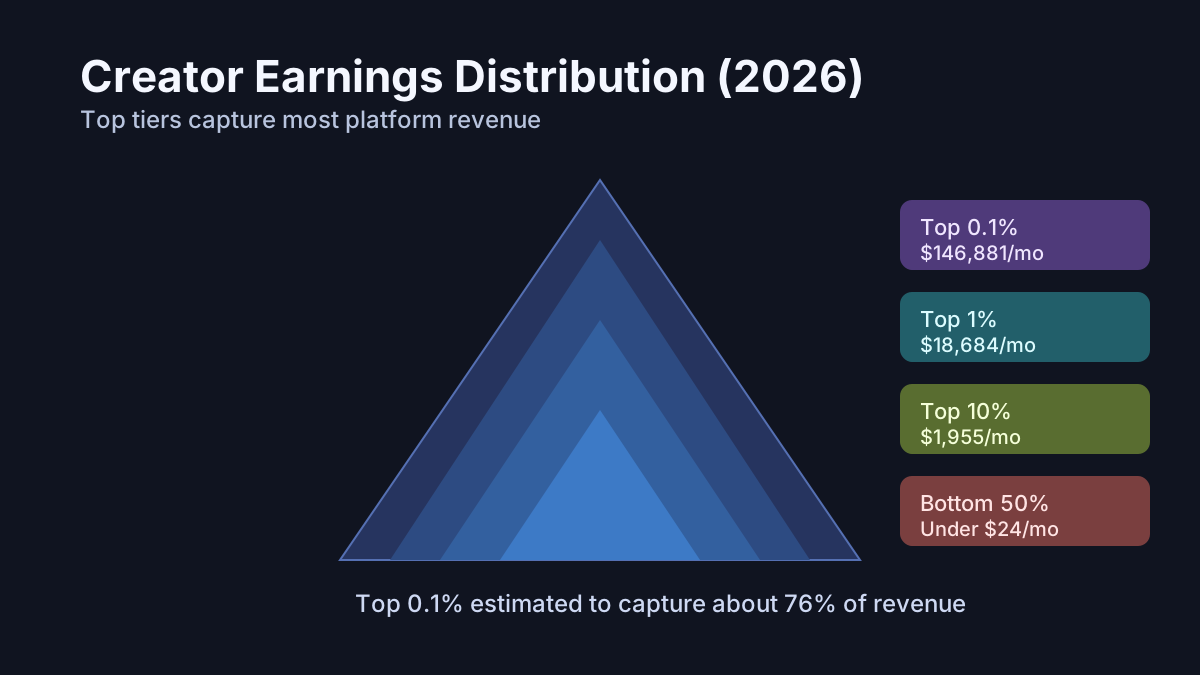
  • Top creator cohorts capture a disproportionate share of payouts, making percentile context more useful than a single average.
  • Top 1% and top 0.1% claims should be checked carefully because celebrity earnings headlines are often overstated or poorly sourced.
  • Real take-home income depends on platform fees, taxes, content costs, marketing costs, and time workload.
  • For a focused look at outlier income claims, read OnlyFans top earners statistics.

Creator Earnings Distribution

OnlyFans creator earnings distribution chart

Creator Earnings Momentum

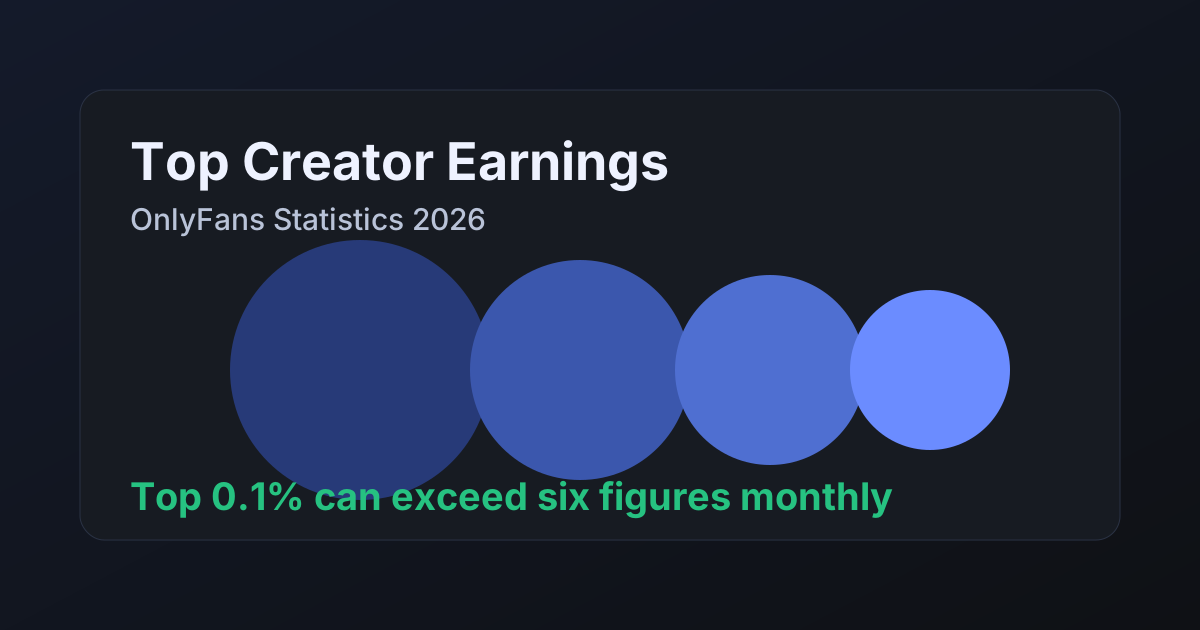
OnlyFans creator earnings momentum and top tier benchmark visual

Creator Earnings Scenario Table

Example scenario modeling using common conversion and spend assumptions after platform fees.

Subscribers Paying rate Avg spend Estimated monthly payout
1,000 3.0% $40.00 $960
2,500 4.2% $48.52 $4,074
5,000 5.0% $55.00 $11,000

Earnings Image Assets

OnlyFans creator earnings distribution screenshot by top percentage tiers
Core creator distribution image.
OnlyFans top creator earnings benchmark screenshot
Top-tier benchmark visual for comparison context.

Benchmark Table: What Different Earnings Tiers Really Mean

Tier framing Directional monthly range Interpretation notes
Entry and early-stage creators Low to modest earnings with high variance Outcomes depend heavily on conversion quality and retention, not posting volume alone.
Middle cohort Meaningful but operationally demanding Requires consistent funnel management, audience fit, and pricing discipline.
Top 10 percent Significantly above platform average Often reflects compounding effects of brand, repeat spend, and strong positioning.
Top 1 percent and above Outlier-level outcomes Not representative of typical creator trajectories; concentration effects are substantial.

This page intentionally avoids presenting a single "expected income" figure because distribution is asymmetric. Averages can be mathematically true and still practically misleading.

Why Average Earnings Are a Weak Standalone Number

Average values in creator platforms are heavily influenced by a small set of top earners. When distribution is skewed, the average can sit well above what a typical creator experiences. This is a classic long-tail dynamic: a minority captures a large share of total outcomes while the median remains substantially lower. If someone uses average earnings as a direct expectation, the forecast usually overstates likely short-term results.

Better analysis starts with range-based scenarios. A conservative scenario should assume slower conversion, lower initial repeat purchase behavior, and higher content-production overhead. A base scenario can incorporate moderate conversion improvements and stable retention. An upside scenario can model stronger differentiation and efficient audience development. This framework makes analysis more resilient and less emotionally reactive.

The most reliable interpretation is to ask how and why a cohort achieves its outcome. Is growth driven by one-time promotions, repeat high-value buyers, pricing strategy, niche differentiation, off-platform audience quality, or operational discipline? Without that causal layer, income benchmarks remain descriptive but not decision-useful.

Concentration Dynamics

Revenue concentration is common in digital marketplaces with strong network effects and asymmetric audience attention. Top cohorts often accumulate compounding advantages in visibility, trust, and repeat behavior. That can create very high earnings ceilings while also widening the gap between headline outcomes and typical outcomes.

Concentration is not inherently negative, but it changes the benchmark conversation. "What is possible?" and "What is probable?" are different questions. Useful statistics should help readers answer both without collapsing them into one metric.

Operational Drivers That Shape Income

  • Conversion efficiency from traffic to paying behavior.
  • Pricing strategy relative to audience willingness to spend.
  • Retention mechanics and repeat purchase sequencing.
  • Offer relevance and messaging quality over time.
  • Consistency in content cadence and audience trust.
  • Cost structure management and time allocation discipline.

In practice, improvements in these drivers usually matter more than headline platform averages.

Cost-Aware Earnings Interpretation

Gross earnings references are often quoted as if they were net income. Real creator economics should account for platform fees, production costs, marketing spend, payment processing realities, taxes, and opportunity cost of time. Two creators with identical gross numbers can experience very different take-home outcomes depending on cost discipline and workflow complexity.

Cost-aware interpretation is especially important when benchmarking top tiers. High gross performance can coincide with substantial operational overhead. For newer creators, sustainable growth usually comes from repeatable systems rather than expensive short-term acceleration tactics.

To avoid confusion, this page focuses on framework quality instead of promising universal earnings formulas. If you need legal or tax interpretation, consult professionals and review our disclaimer and terms of use.

Practical Benchmarking Framework

A practical framework for creator earnings benchmarking has five steps. First, define your current stage: early, mid, or scaling. Second, establish baseline conversion and repeat purchase metrics. Third, set a realistic range for pricing and retention improvements over the next quarter. Fourth, include costs explicitly before calculating target take-home outcomes. Fifth, review performance weekly but evaluate strategy shifts on a longer cadence to avoid reacting to random variance.

This process turns external statistics into operational guidance without overfitting to public anecdotes. It also helps teams discuss progress in objective terms. Instead of asking whether a monthly total matched an aspirational benchmark, ask whether conversion quality, retention depth, and unit economics improved in the expected direction.

Better process does not guarantee top-percentile outcomes, but it improves decision quality and reduces avoidable errors. In creator markets, consistency often compounds more reliably than short-lived viral spikes.

Frequently Asked Questions

Is the average creator earnings number useful at all?

It is useful as a directional context marker, but not as a personal expectation. Distribution skew means typical outcomes can be much lower than the average.

How should new creators use benchmark ranges?

Use ranges to set scenario-based goals and monitor process metrics such as conversion and retention, rather than targeting a single public number.

Why does this page link to user and revenue pages?

Earnings outcomes are shaped by demand depth and monetization structure. Reading those pages together gives a more accurate interpretation than any single earnings stat.

Where can I review publishing standards and limits?

Visit Editorial Policy, About Us, and Disclaimer.

Extended Benchmarking Notes

Earnings benchmarks are most effective when paired with process metrics. A monthly total alone rarely explains whether performance is improving in a durable way. Process indicators such as conversion quality, repeat purchase cadence, retention depth, and offer relevance reveal whether gains are likely to persist. Without those indicators, teams may react to random variance as if it were structural change.

Distribution-aware analysis is equally important. In skewed ecosystems, top-tier outcomes can be statistically accurate and simultaneously unrepresentative for most participants. Benchmark models should therefore start with percentile-informed ranges rather than single benchmark targets. A range approach reduces emotional volatility and encourages disciplined experimentation.

Cost structure should be tracked as closely as gross income. Platform fees are only one component. Production overhead, messaging workload, campaign costs, tax treatment, and opportunity cost all influence take-home outcomes. Two strategies with similar gross results can have very different profitability profiles depending on operational discipline.

We also recommend periodic assumption audits. If conversion improves but retention weakens, revise pricing and communication strategy instead of scaling spend immediately. If retention improves but acquisition stalls, investment in discovery and brand positioning may be more effective than further discounting. These trade-offs are why benchmark interpretation should be tied to system dynamics, not isolated leaderboard narratives.

Readers using this page for strategic decisions should connect it with audience dynamics and monetization mechanics. That three-page sequence helps explain not only what earnings look like, but why outcomes distribute the way they do.
Quarterly Review Template

A practical quarterly review can follow a simple template: first compare outcome ranges against prior assumptions; second, identify whether variance was driven by conversion, retention, pricing, or cost; third, decide one to two operational priorities for the next cycle; fourth, define how success will be measured before new experiments begin. This discipline helps avoid constant strategy switching based on short-term noise.

Benchmarking is strongest when it supports deliberate iteration. Public statistics provide boundaries and context; internal process metrics guide execution. Combining both perspectives usually produces more stable progress than relying on either alone.

For readers publishing their own analyses, preserve uncertainty language and include source context so benchmark figures are not misread as promises.

Final Practical Note

Treat benchmark tables as orientation tools, then calibrate with your own operational data. Interpretation quality improves when external context and internal metrics are reviewed together over multiple cycles rather than one period.

This page is designed for disciplined analysis, not guaranteed projections, and should be read with user and revenue pages for full-system context.

Additional Guidance

Keep benchmark reviews tied to process improvements. Sustainable earnings usually result from repeated optimization of conversion, retention, and cost discipline rather than one-time growth spikes.

Use this page as context and pair it with internal measurement for final strategy decisions.

Closing Note

Sustainable creator performance is usually a compounding process. Use benchmark ranges as directional boundaries and refine decisions with recurring measurement cycles.

Supplemental Note

Earnings interpretation should remain probability-aware. Benchmark ranges help frame possibilities, but outcomes depend on execution quality, audience fit, and changing market conditions over time.

Revisiting assumptions quarterly improves reliability and reduces reaction to short-term variance.

Documentation discipline also improves long-run benchmarking quality.