Audience behavior deep dive

OnlyFans Demographics and Traffic Statistics 2026

OnlyFans demographics are harder to interpret than platform revenue because many audience details come from third-party traffic panels rather than official user disclosures. This page explains what the available traffic and demographic indicators can tell us, where they are useful, and where they should be treated carefully.

TLDR: OnlyFans Demographics and Traffic

  • OnlyFans has hundreds of millions of registered fan accounts, but monthly active users are much lower than total accounts.
  • Mobile traffic dominates, with ranking pages frequently citing mobile as more than 80% of visits.
  • The United States is the largest traffic market, commonly cited around 48%-49% of global traffic in third-party estimates.
  • Gender and age data often come from traffic panels, so exact percentages should be treated as directional rather than official platform disclosures.
  • Traffic statistics are most useful when paired with conversion, retention, and creator earnings data.

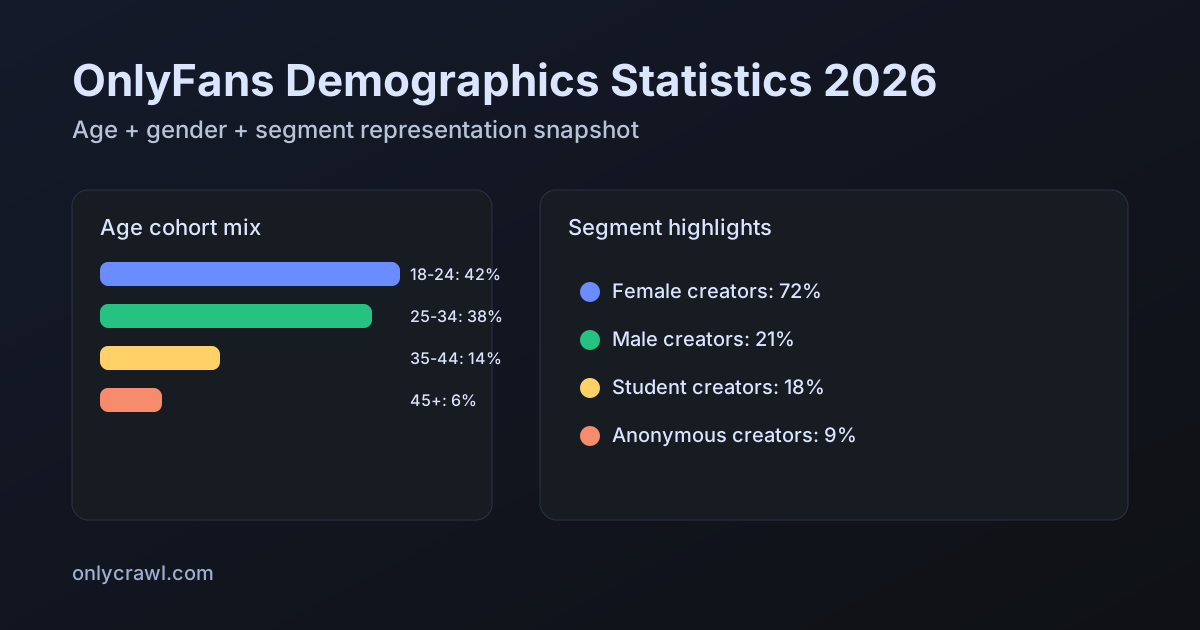
Demographics Visual

OnlyFans demographics statistics visual

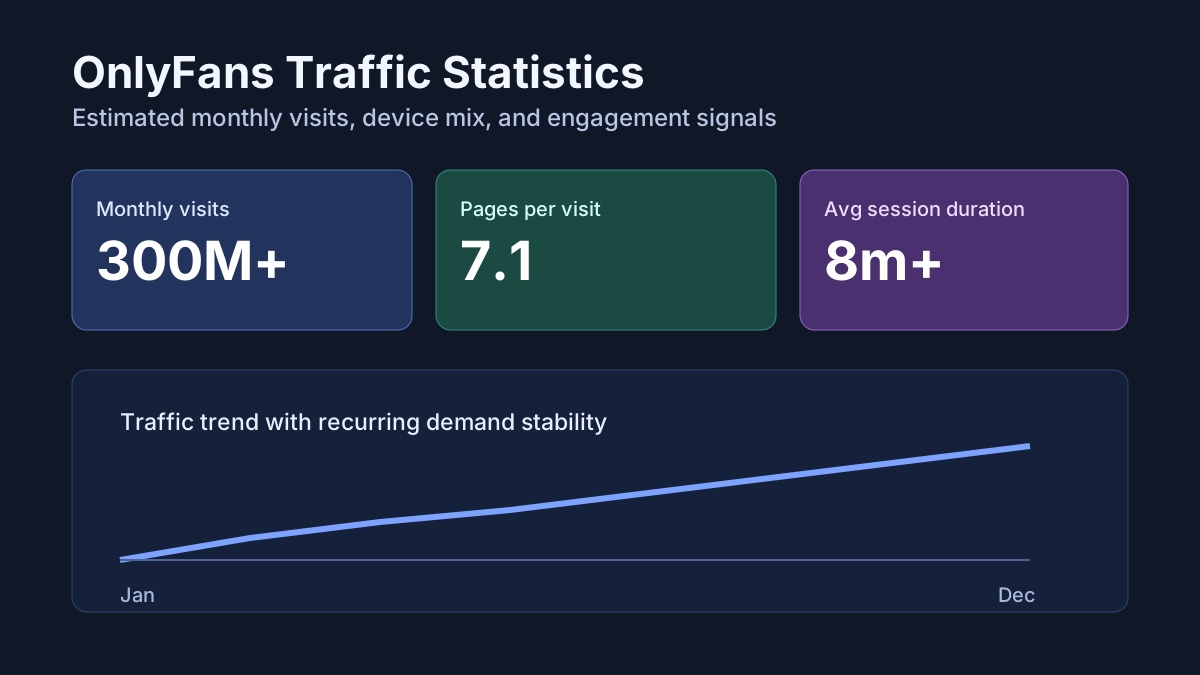
Traffic Visual

OnlyFans traffic statistics trend visual

Key Traffic and Demographic Statistics

Metric Commonly cited benchmark Best interpretation
Registered fan accounts 377.5M latest public cycle Total account base, not active users or payers.
Monthly active users 75M-120M estimates Directional activity range; source methods vary.
Mobile traffic share ~84.1% cited by statistics pages Strong signal that the platform is mobile-first.
United States traffic share ~48%-49% in third-party estimates Shows heavy US dependence in audience discovery.
UK traffic share ~6% cited range Important secondary English-language market.

Why Registered Users Are Not the Same as Active Users

The most important demographic caveat is the gap between registered users and active users. Registered accounts measure the cumulative account base. They include people who signed up, visited once, lost interest, returned later, or never converted into paying behavior. Monthly active users measure a narrower group. Paying users are narrower still. These layers should not be mixed.

This distinction matters because OnlyFans statistics are often used in market-size discussions. A platform with 377.5M registered accounts is obviously large, but that does not mean hundreds of millions of people are actively spending every month. The more useful question is how much of the registered base becomes recurring traffic and how much of that traffic becomes monetized behavior.

For creators and agencies, active user quality matters more than total account count. A smaller audience with strong spending intent can be more valuable than a larger audience with low trust or low willingness to pay. That is why traffic and demographics should be read alongside revenue statistics and creator earnings statistics.

Mobile Traffic: Why OnlyFans Is a Mobile-First Platform

Third-party statistics pages frequently cite mobile as the dominant source of OnlyFans visits, often around the mid-80% range. Even if the exact percentage varies by source and month, the direction is clear: OnlyFans should be analyzed as a mobile-first marketplace. Discovery, messaging, subscription decisions, and repeat content consumption are heavily shaped by small-screen behavior.

Mobile dominance changes how statistics should be interpreted. Conversion friction is different on mobile than desktop. Content preview behavior is different. Session length, return frequency, and payment flow can all be influenced by device. A creator strategy that looks sensible on desktop may underperform if it ignores mobile-first reading, viewing, and messaging patterns.

For readers evaluating platform health, mobile share is also a durability signal. A platform that fits habitual mobile behavior can support frequent return visits. However, mobile traffic alone does not prove high monetization quality. It must be paired with repeat spend, retention, and conversion metrics.

Gender and Age Demographics: Useful, but Easy to Overstate

Gender and age statistics for OnlyFans are commonly discussed, but many figures come from third-party panels or traffic tools rather than official platform disclosures. These tools can be useful for directional context, especially when they show consistent patterns across time. They are less reliable when used as exact population measurements.

In practice, demographic interpretation should focus on broad behavior rather than false precision. Does traffic skew toward younger adult users? Is the audience heavily mobile? Are English-speaking markets overrepresented? Do traffic patterns align with revenue concentration? Those questions are more useful than debating a single exact percentage when source methods are not fully visible.

Demographics also differ by content category, geography, and acquisition channel. A creator whose traffic comes from Reddit may see different audience composition than one whose traffic comes from Instagram, X, TikTok, or search. Platform-wide demographics are a starting point, not a substitute for creator-level analytics.

Country Traffic: Why the United States Matters So Much

The United States is consistently cited as the largest OnlyFans traffic market, often around 48% to 49% of global traffic in third-party estimates. That matters because traffic concentration can create both opportunity and risk. A large US audience supports high spending volume, but it also means legal, payment, and cultural changes in one country can affect the platform disproportionately.

The UK, Mexico, Germany, Spain, Canada, and other markets appear as secondary contributors in various traffic and country-statistics summaries. The country mix is important because spending behavior, creator supply, payment acceptance, language, and content norms differ by market. For more detail, see OnlyFans statistics by country.

Traffic Sources and Creator Discovery

OnlyFans is not usually discovered in isolation. Fans often arrive from social media, creator link pages, messaging apps, search, referral traffic, or direct visits after seeing a creator elsewhere. This makes traffic analysis different from a platform that relies mostly on internal discovery. The audience may be registered on OnlyFans, but demand is frequently generated outside OnlyFans.

That matters for demographic interpretation. A creator who brings traffic from Reddit may attract a different audience than one who promotes through Instagram, X, TikTok, YouTube, Twitch, or search. Platform-wide demographics can describe broad averages, but acquisition channel demographics determine what a specific creator experiences. That is one reason creator outcomes vary so widely even when platform-level user totals look strong.

From a statistics perspective, traffic source quality is often more important than traffic volume. High-volume low-intent visitors may browse and leave. Lower-volume high-intent visitors may subscribe, tip, purchase PPV, or return repeatedly. This is why the most useful traffic dashboard would combine visits, source, device, conversion, retention, and spend depth rather than counting sessions alone.
How Demographics Influence Monetization

Demographics influence monetization because users differ in trust, payment comfort, device behavior, income, content preferences, and willingness to subscribe repeatedly. Age distribution can influence price sensitivity and platform familiarity. Country distribution can influence payment acceptance, currency effects, and cultural norms. Gender mix can influence what kinds of content categories receive the most demand.

However, broad demographic labels should not be treated as destiny. A creator serving a narrow niche can outperform broader demographic expectations if the audience has high intent and strong retention. Conversely, a creator with a seemingly favorable demographic audience may underperform if messaging, pricing, trust, or cadence are weak. Demographics describe the market environment; they do not replace funnel quality.

The most practical use of demographic statistics is benchmark calibration. If a platform is heavily mobile, pages and offers should be easy to understand on mobile. If a market is heavily US-based, timing and cultural references may be optimized for that audience. If traffic is concentrated in mature markets, growth may require better retention rather than simply more awareness.

What to Watch Next in OnlyFans Audience Data

The next useful wave of OnlyFans audience statistics will not be just bigger user totals. The more important questions will be about activity quality. How many registered accounts are active monthly? What share of active users pay? How much repeat spending comes from messages, tips, subscriptions, and PPV? Are new users less valuable than older cohorts? Are growth markets converting at similar rates to mature markets?

If public reporting improves, the best statistics pages will separate registered users, active users, paying users, and high-value repeat spenders. Until then, readers should treat traffic and demographic data as directional context and avoid turning broad audience indicators into precise income forecasts.

Best Way to Cite Demographic and Traffic Data

Demographic and traffic statistics should be cited with more caution than official financial figures. If a figure comes from a traffic panel, describe it as an estimate or third-party traffic benchmark. If a percentage refers to visits rather than registered users, say so clearly. This prevents readers from mistaking browser behavior for total platform population.

A strong citation also includes the month or year of the estimate because traffic composition can shift quickly. Device share, country mix, and referral patterns can change after platform policy changes, creator migration, media events, or seasonal traffic swings.