Historical platform timeline

OnlyFans Historical Statistics: Revenue, Users, Creators, and Growth Forecasts to 2030

OnlyFans is usually discussed through its latest headline numbers, but the historical timeline is more useful. The platform moved from niche creator monetization to pandemic-era hypergrowth and then into a more mature marketplace where growth still exists but no longer looks explosive.

TLDR: Historical OnlyFans Statistics

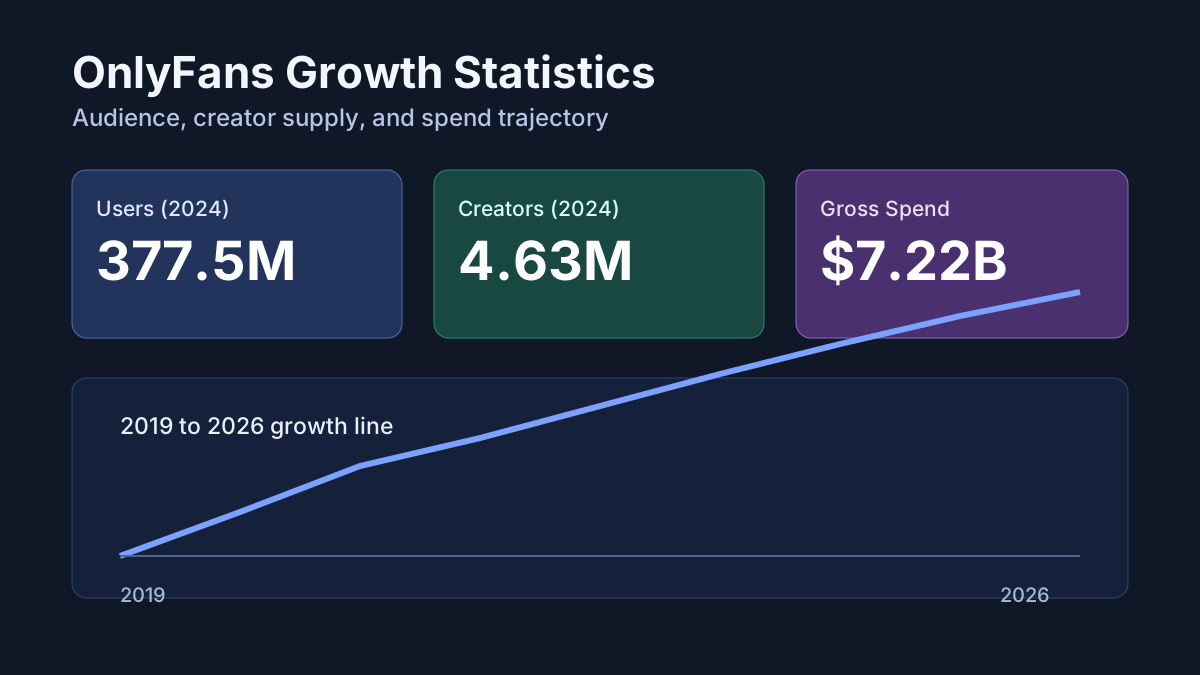
  • Gross payments rose from roughly $270M in 2019 to about $7.22B in FY2024.
  • FY2020 and FY2021 were the breakout years; later growth remained positive but slowed sharply.
  • Creator accounts reached about 4.63M and fan accounts reached about 377.5M in the latest reporting cycle.
  • The platform’s 80/20 payout model means creator payouts scale with gross payments, while retained platform revenue is about one-fifth of volume.
  • The modelled forecast extends to 2030 and estimates $9.75B in gross fan spend, 675M registered fan accounts, and 6.75M creator accounts by 2030.
  • The main historical lesson is maturity: OnlyFans is still large, but its future is shaped by retention, monetization depth, and market mix more than raw awareness.

Historical Growth Chart

OnlyFans historical growth chart showing revenue users and creators

Why the Timeline Matters

A single-year statistic can make OnlyFans look like a permanently accelerating company. A timeline shows a different story: rapid adoption, dramatic monetization expansion, then deceleration into a large but more mature creator platform. That distinction matters for analysts, creators, agencies, and writers because mature platforms behave differently from breakout platforms.

Mature growth is not bad. It simply changes which statistics matter. Early-stage platforms are measured mostly by awareness and acquisition. Mature platforms are measured by repeat spending, payer quality, creator retention, and whether growth comes from new geography, new users, or deeper monetization of existing audiences.

OnlyFans Historical Data Table

Year Gross payments / spend Users Creators Interpretation
2019 ~$270M Early scale Hundreds of thousands Pre-pandemic base year before mass creator-economy acceleration.
2020 ~$2B+ Rapid expansion Creator adoption surged Pandemic-era breakout; growth rates were unusually high.
2021 ~$4.8B ~170M cited accounts Multi-million range OnlyFans became mainstream in creator economy discussions.
2022 $5.55B ~198M ~3.21M Growth continued, but the post-breakout phase had begun.
2023 $6.63B ~305M ~4.12M Large-scale marketplace with strong reported creator payouts.
2024 $7.22B 377.5M 4.63M Still growing, but now at a mature single-digit pace.
2025 estimate $7.55B 425M 5.05M Modelled bridge year based on mature growth after FY2024.
2026 estimate $7.95B 477M 5.45M Full-year trend estimate, not official final-year disclosure.
2027 forecast $8.40B 525M 5.80M Assumes continued growth with mature-platform deceleration.
2028 forecast $8.85B 575M 6.15M Assumes moderate expansion in users and creators.
2029 forecast $9.30B 625M 6.45M Assumes stable monetization depth rather than breakout growth.
2030 forecast $9.75B 675M 6.75M Modelled long-range estimate; use as scenario input only.

Forecast rows are OnlyCrawl modelled estimates based on the historical trend line and should not be treated as official OnlyFans disclosures.

Projected Payout and Platform Revenue Through 2030

Because OnlyFans uses a widely cited 80/20 split, modelled gross fan spend can be translated into creator payout and retained platform revenue estimates. This is a mechanical projection, not a claim that the platform has published these future numbers.

Year Gross fan spend Creator payout estimate Platform retained revenue estimate
2026 estimate $7.95B $6.36B $1.59B
2027 forecast $8.40B $6.72B $1.68B
2028 forecast $8.85B $7.08B $1.77B
2029 forecast $9.30B $7.44B $1.86B
2030 forecast $9.75B $7.80B $1.95B

2019-2021: From Niche Monetization to Breakout Growth

The most important historical period for OnlyFans is the jump from 2019 through 2021. Before the pandemic, OnlyFans already had a monetization model that was attractive to creators: direct payment, recurring subscriptions, messages, tips, and an 80/20 split. What changed during the pandemic was the size of the creator and consumer audience willing to use that model.

The growth from roughly $270M in 2019 to multiple billions in the following years was not a normal gradual adoption curve. It reflected an unusual combination of locked-down consumers, creators seeking online income, social media distribution, and mainstream media attention. That is why historical growth rates from this period should not be projected forward as if they represent the normal state of the business.

In this phase, the most useful metrics are awareness, gross payment growth, and creator adoption. Platform quality questions such as retention and long-term payer behavior mattered, but the headline story was raw expansion. OnlyFans became one of the clearest examples of how quickly direct-to-fan monetization can scale when demand, supply, and payment infrastructure align.

2022-2024: Maturity, Payout Scale, and Slower Growth

By 2022, OnlyFans was no longer simply a breakout platform. It had become a large marketplace with millions of creators and hundreds of millions of accounts. The reported $5.55B gross payments figure for 2022 gave analysts a clearer view of platform scale, while later numbers from 2023 and 2024 confirmed that the platform could keep growing even after the pandemic surge cooled.

The 2023 and 2024 figures are especially useful because they show both strength and deceleration. Gross payments increased from about $6.63B to $7.22B, and creator payouts remained enormous in aggregate. At the same time, percentage growth was far lower than the early breakout years. This is exactly what usually happens when a platform becomes large: absolute dollars can keep rising while percentage growth slows.

For readers trying to understand where OnlyFans is now, this is the key historical takeaway. The platform is not in the same phase it was in during 2020. It is better understood as a mature, high- volume creator marketplace where future growth depends on monetization quality, geography, payment resilience, creator retention, and how effectively audiences continue converting from curiosity into paid behavior.

What Historical Statistics Reveal About Future Growth

Historical statistics do not predict the future automatically, but they define a reasonable boundary for expectations. If a forecast assumes another pandemic-style growth curve, it probably overstates the case. If a forecast assumes zero growth because percentage rates slowed, it may understate the platform’s ability to compound from a very large base. A balanced view recognizes both scale and maturity.

The best future-facing analysis will connect this history to other pages: user statistics for audience scale, revenue statistics for monetization, creator earnings statistics for outcomes, and country statistics for regional growth differences. The historical timeline is the spine that helps those other metrics make sense.

How Revenue, Users, and Creators Should Be Read Together

Historical OnlyFans statistics become much more useful when the three major time series are read together: gross payments, registered users, and creator accounts. Gross payments show how much money flows through the platform. Registered users show the size of the audience base. Creator accounts show the size of the supply side. None of those figures is complete alone. A platform can add users while monetization per user declines, add creators while average visibility gets harder, or grow gross payments while earnings remain concentrated among a small share of creators.

The most useful historical question is therefore not simply “how big did OnlyFans get?” A better question is “which layer grew fastest, and what did that imply?” When fan accounts grow faster than creators, the marketplace can look more favorable for creators because demand depth improves. When creators grow faster than monetized demand in a niche, competition increases even if the platform is larger overall. When gross payments grow faster than users, monetization depth may be improving. When gross payments grow slower than users, new accounts may be less valuable than earlier cohorts.

This layered reading helps explain why the same OnlyFans statistic can support different conclusions depending on context. A journalist may focus on the platform’s gross payment scale. A creator may care more about whether the average audience is still willing to pay. An agency may care about whether creator-side supply is getting more crowded. Historical data does not remove that complexity, but it gives each reader a timeline for interpreting it.

Historical Caveats: Why Exact Numbers Can Differ by Source

OnlyFans historical numbers sometimes differ across articles because sources may use different fiscal years, calendar years, definitions, and estimation methods. Official filings from Fenix International are the strongest source for company financials, but those filings may not answer every user-behavior question. Traffic tools can estimate visits or geography, but they are not the same as internal platform analytics. Creator census studies can be useful, but they often rely on sampling, modeling, and classification methods.

For that reason, the safest approach is to treat historical figures as a structured evidence map rather than a perfect ledger. When two credible sources disagree slightly, the direction and definition often matter more than the final decimal. If both show explosive early growth and slower later growth, the strategic conclusion is stable. If one uses registered accounts while another uses monthly active users, the figures should not be compared directly.

The strongest historical analysis states the unit of measurement, the period, and the likely source type. That is why this page uses language such as “gross payments,” “registered fan accounts,” and “creator accounts” rather than treating every platform metric as generic “revenue” or “users.”
Best Way to Cite Historical OnlyFans Data

When citing historical OnlyFans statistics, name the year, metric, and source type in the same sentence. For example, “FY2024 gross payments were about $7.22B according to summaries of Fenix International filing data” is clearer than “OnlyFans made $7.22B.” The first phrasing tells readers the timeframe, the metric layer, and why the number should be treated as stronger than a generic internet estimate.

Historical citations should also avoid implying that past growth rates will repeat. A good citation uses the timeline to explain maturity, not to promise future acceleration. That small caveat can prevent a historical statistic from being misread as a forecast.