Monetization and payout analysis

OnlyFans Revenue Statistics 2026

Revenue headlines are often quoted without enough explanation of what the numbers include. This page separates gross platform spending from net platform retention and creator payout flows, then explains how to interpret those layers responsibly. For reader continuity, connect this analysis to user statistics and creator earnings statistics.

TLDR: OnlyFans Revenue Statistics

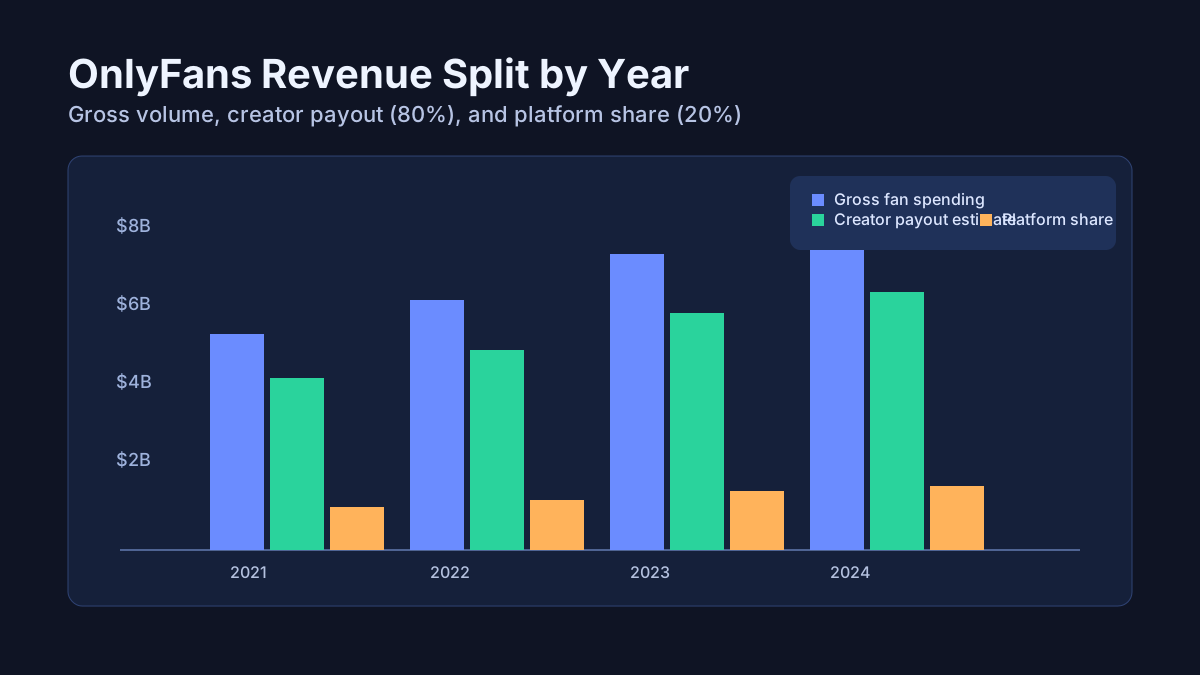
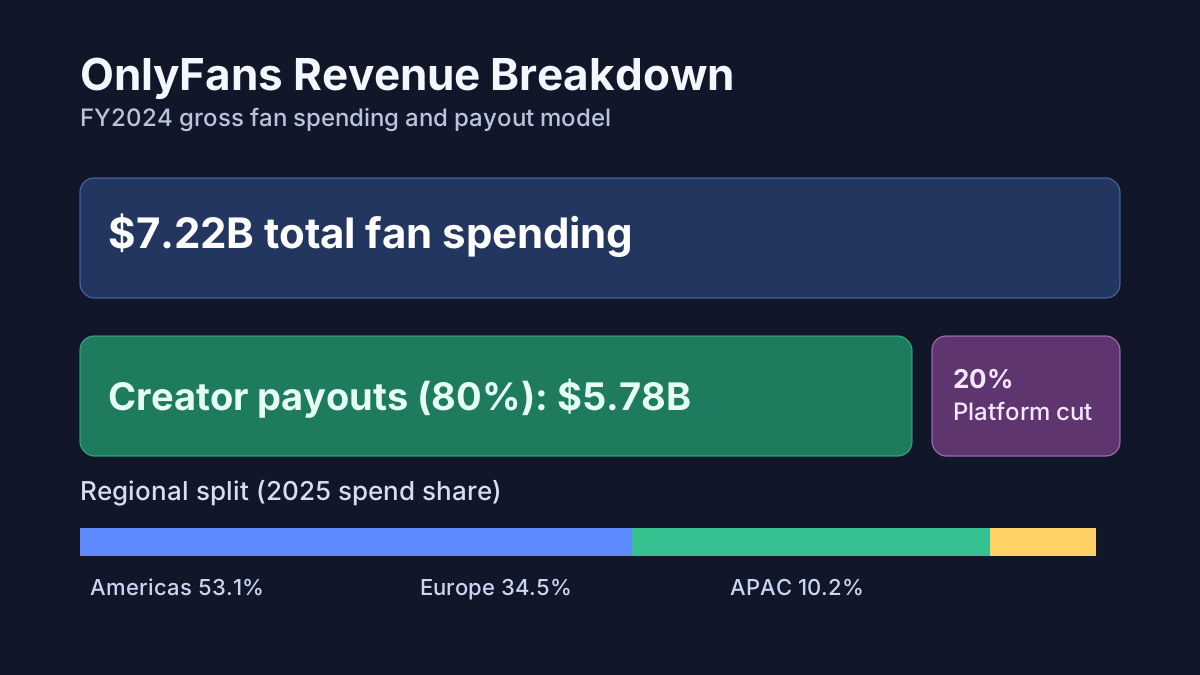
  • OnlyFans gross payments reached about $7.22B in FY2024, up from $6.63B in FY2023.
  • The platform keeps roughly 20% of fan payments, so gross payments and platform revenue are different metrics.
  • Creator payouts were about $5.78B in FY2024, while platform retained revenue was about $1.41B.
  • Revenue growth has slowed from pandemic-era hypergrowth to mature single-digit or low-double-digit expansion.
  • For a year-by-year view, read OnlyFans historical statistics.

Revenue Trend Visualization

OnlyFans revenue trend and payout split visual

Monetization Mix Visualization

OnlyFans monetization mix chart visual

Revenue Screenshots and Graphics

OnlyFans revenue breakdown screenshot with creator payout and platform share
Core payout split visual.
OnlyFans revenue split bar chart screenshot asset
Alternative revenue composition chart image.

Regional Spend Table (Auto-updated)

Region Spend Share
Americas $3.83B 53.10%
Europe $2.49B 34.50%
APAC $0.73B 10.20%
Middle East $0.06B 0.86%
Africa $0.10B 1.34%

Revenue Structure Snapshot

Revenue layer What it represents Interpretation guidance
Gross platform spend Total user transaction volume across monetized actions. Use as market size context, not as platform take-home income.
Creator payout share Large majority distributed to creators before taxes and external costs. Useful for creator-side economy scale and payout sensitivity analysis.
Platform retained revenue Smaller portion retained as net platform revenue. Relevant for business model sustainability and operating leverage studies.
Revenue quality layer Repeat purchases, conversion efficiency, and churn-adjusted retention. Most important for forecasting durability beyond short-term spikes.

OnlyFans Revenue Forecast: 2026-2030

The forecast below extends historical revenue trends into future full-year estimates. These are modelled projections, not official company disclosures. The assumptions are intentionally conservative: continued growth, but no return to pandemic-era hypergrowth.

Year Gross fan spend Creator payouts (80%) Platform retained revenue (20%) Growth interpretation
2026 estimate $7.95B $6.36B $1.59B Mature growth from the FY2024 baseline.
2027 forecast $8.40B $6.72B $1.68B Moderate expansion with slower percentage growth.
2028 forecast $8.85B $7.08B $1.77B Growth depends more on retention and spend depth.
2029 forecast $9.30B $7.44B $1.86B Large absolute-dollar growth despite modest percentage growth.
2030 forecast $9.75B $7.80B $1.95B Scenario estimate approaching a $10B gross-payment market.

Gross Versus Net: The Core Concept People Miss

In creator platforms, gross spending and net platform revenue are not interchangeable numbers. Gross spending reflects what users spend in total. Net platform revenue reflects what the platform retains after creator payout share. Confusion between these layers can produce dramatic errors in reporting and strategic analysis. For example, a statement about multi-billion gross volume may sound equivalent to multi-billion retained platform revenue, but those figures describe different economic outcomes.

The payout split also influences sensitivity. If gross volume rises but monetization mix shifts toward lower-margin transaction categories, retained revenue may grow slower than expected. If gross volume is stable but repeat spending quality improves, retained revenue can look more resilient than top-line growth alone suggests. Revenue analysis therefore works best when transaction composition, cadence, and retention behavior are considered together.

This distinction is also why creator-side expectations should not be anchored to top headlines alone. A large market can still produce concentrated outcomes if spending depth is uneven and discoverability is competitive. That is why this page intentionally links to earnings distribution context rather than treating gross platform volume as a proxy for typical creator income.

Revenue Quality Indicators

Strong revenue quality usually appears as a combination of stable repeat purchases, healthy renewal behavior, and conversion efficiency that does not depend on permanent discounting. When these signals improve together, revenue durability typically rises. When growth relies on one-off spikes or aggressive short-term promotions, top-line numbers may still look strong while underlying quality weakens.

Analysts should also examine concentration. If a small segment drives a very large share of monetized activity, platform outcomes can remain positive but become more volatile. Concentration is not automatically a problem, but it does change risk profile and interpretation.

Forecasting Without Overfitting

Revenue forecasts become fragile when they extrapolate a single strong year indefinitely. A more robust method splits projections into acquisition effects, conversion effects, spending-depth effects, and retention effects. This decomposition makes assumptions explicit and easier to stress test. It also allows teams to update one component when new data arrives without rebuilding the entire model from scratch.

For external readers, the key takeaway is simple: a good forecast acknowledges uncertainty ranges and scenario boundaries. Precision without uncertainty disclosure is usually performative rather than informative.

Scenario Framing for Revenue Interpretation

A practical way to analyze platform revenue is to define three scenarios. In a base scenario, user growth continues moderately, conversion remains stable, and repeat spending quality does not deteriorate. In an upside scenario, retention and monetization depth improve, allowing higher value extraction from existing demand even if acquisition growth slows. In a downside scenario, user acquisition remains positive but repeat behavior weakens, pushing realized revenue below top-line account expectations.

This scenario approach is not limited to professional investors. Content operators, agencies, and independent creators can use the same logic for communication, pricing, and campaign pacing. By separating assumptions explicitly, teams reduce emotional overreaction to short-term headline swings and make more consistent decisions.

Scenario framing also improves internal linking quality for readers. People who land on this page for one number often need adjacent context on demand or distribution. We therefore keep direct links to user demand context and creator distribution context throughout the page and in the sitewide footer.

Benchmark Use Guidance for Journalists and Analysts

  • Always specify whether a cited value is gross volume, payout estimate, or retained revenue.
  • Add timeframe qualifiers so readers know whether the figure is annual, quarterly, or projected.
  • Avoid converting platform-level outcomes directly into typical creator outcomes.
  • Use range wording when source quality or timing differences create uncertainty bands.
  • Prefer topical cross-linking over single-page claims to preserve analytical context.
  • Disclose assumptions clearly when offering derived calculations or scenario estimates.

These standards are part of the broader publishing framework documented in our editorial policy. They exist to keep pages useful under uncertainty and to reduce accidental misuse of high-visibility statistics.

Frequently Asked Questions

Is gross spending the same as platform profit?

No. Gross spending is total user transaction volume. Profit depends on retained revenue and operating costs, which are separate layers.

Can revenue keep growing if user growth slows?

Yes. Revenue can continue growing through higher conversion quality, stronger repeat behavior, and improved monetization mix even when acquisition growth moderates.

What should I read next after this page?

Read user statistics for demand context and creator earnings statistics for distribution outcomes.

Where are legal and quality standards documented?

See Disclaimer, Terms of Use, and Editorial Policy.

Extended Monetization Notes

Revenue interpretation improves significantly when teams track unit economics over storytelling metrics. Instead of asking only whether top-line spend increased, ask whether conversion quality, repeat purchase depth, and retention-adjusted spending all moved in the same direction. If one metric improves while the others decline, reported growth may be less durable than it appears.

Timing effects also matter. Promotional events can pull demand forward and temporarily inflate period revenue, then create weaker follow-through in later periods. Without a timing lens, analysts may label this pattern as sustainable trend growth. To reduce that risk, compare period-over-period behavior with a broader baseline and include notes on campaign cadence, discounting intensity, and audience segment mix where available.

Revenue layer definitions should be carried into every downstream discussion. If a chart uses gross transaction volume, label it explicitly. If a benchmark uses estimated retained share, note the payout assumption and its limitations. If a forecast uses blended scenarios, disclose which parameters are fixed and which are variable. Good disclosure does not weaken analysis; it makes analysis reusable and auditable.

Another common pitfall is treating platform-level monetization as equivalent to average creator economics. Platform revenue can grow while creator outcomes remain highly uneven, especially in concentrated markets. For that reason, this page is intentionally linked to creator earnings distribution context so readers can separate aggregate success from typical participant outcomes.

For practical analysis, use conservative, base, and upside scenarios with explicit assumptions about conversion, repeat activity, and churn pressure. Scenario discipline helps teams avoid overfitting to one quarter or one viral cycle. It also improves communication quality: stakeholders can discuss which assumptions changed instead of arguing over unexplained forecast swings.
Operational Use Case Example

Consider a quarter where gross volume increases but retained economics underperform expectations. Without structure, teams may assume reporting error. With structure, the explanation is often straightforward: monetization mix shifted, retention softened, or discount intensity increased. Each cause suggests a different operational response. Mix changes may require product sequencing updates. Retention softness may require lifecycle optimization. Discount dependence may require offer strategy redesign to protect long-run value.

In practice, this means revenue dashboards should pair top-line figures with quality diagnostics. Doing so turns reporting into strategy support rather than post-hoc narration. It also helps explain why one period can look strong in volume terms but weak in durability terms.

This page is designed to support exactly that interpretation workflow and should be used with linked user and creator pages for complete context.

Final Practical Note

Use this page as a framework for interpreting monetization quality, then validate with your own period-specific assumptions and confidence ranges before final decisions.

Additional Guidance

Always clarify whether cited values represent gross volume, estimated retained share, or creator-side payout context before using them in analysis.

Closing Note

Revenue analysis is strongest when paired with transparent assumptions and cross-page context.

Supplemental Note

Preserve context when citing revenue figures so readers understand whether values are gross totals, retained estimates, or payout-related benchmarks.

Visual Analysis Addendum

Revenue visuals help readers quickly separate structural patterns from one-off narrative spikes. The trend chart highlights long-horizon direction, while the mix chart clarifies where monetization weight is concentrated. Use both views together before drawing conclusions about durability. A strong top-line path with weakening mix quality often requires a different interpretation than a moderate top-line path with stable repeat monetization.

If you embed these visuals in external reports, include notes on timeframe and model assumptions so readers can evaluate comparability across sources. Context-preserving citations improve analytical quality and reduce the risk of repeating gross-versus-net confusion in derivative content.