Earnings concentration deep dive

OnlyFans Top Earners Statistics 2026

OnlyFans top earner statistics are among the most searched and most misunderstood numbers in the creator economy. This page explains what the top 1%, top 0.1%, and celebrity earnings claims actually mean, why outlier incomes distort averages, and how to interpret top-earner data responsibly.

TLDR: OnlyFans Top Earners

  • The top creator cohorts capture a disproportionate share of OnlyFans revenue, making earnings distribution extremely uneven.
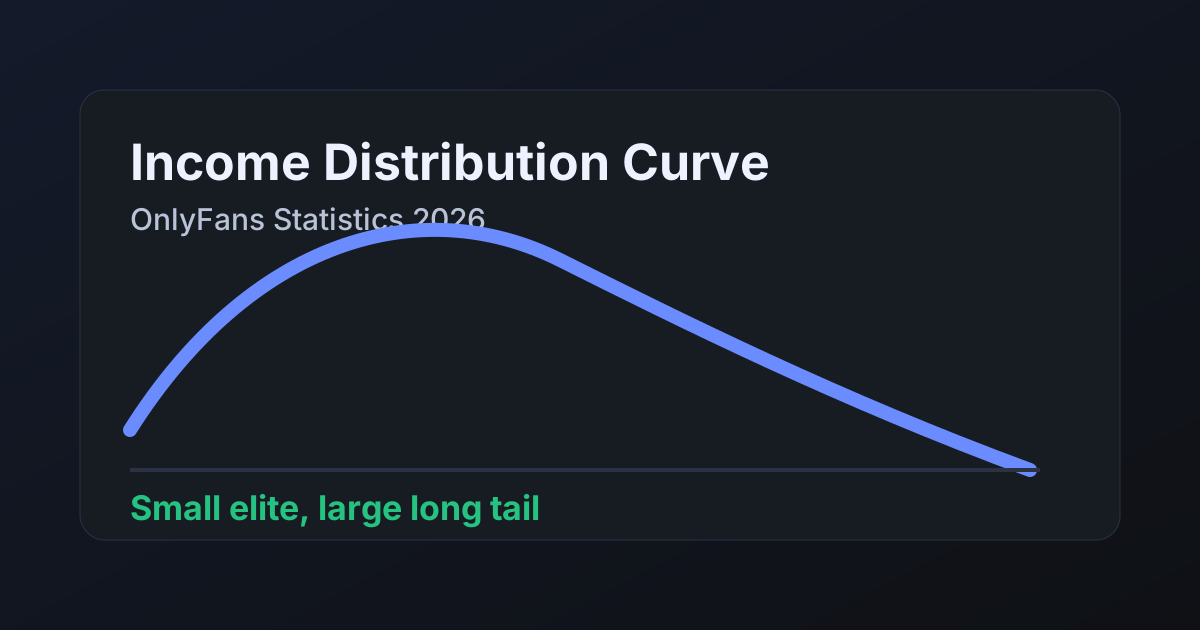
  • Ranking pages cite top 1% creators as capturing around one-third of payouts, while top 0.1% concentration estimates can be even more extreme.
  • The commonly cited average creator income around $131/month is not a typical top-earner benchmark; it is pulled by outliers and platform-wide distribution.
  • Celebrity earnings claims are often inflated, repeated without verification, or based on short-term spikes rather than durable income.
  • Top-earner statistics are useful only when paired with cost, tax, workload, marketing, and retention context.

Top Earner Visual

OnlyFans top creator earnings statistics visual

Earnings Distribution Visual

OnlyFans income distribution statistics visual

OnlyFans Top Earner Benchmark Table

Creator tier Commonly cited benchmark Interpretation warning
Average creator ~$131/month after platform fees Not representative of top earners; also not necessarily median.
Top 10% Often cited as capturing most platform earnings Includes a wide range from strong side income to professional operations.
Top 1% Frequently cited around one-third of payouts Outlier cohort; not a realistic baseline for new creators.
Top 0.1% Some summaries cite extreme concentration and six-figure monthly averages Very sensitive to methodology and outlier inclusion.
Celebrity claims Often reported as headline monthly numbers Needs verification; legal records have contradicted some viral claims.

Why Top 1% Statistics Are So Different From Average Earnings

Top 1% OnlyFans statistics describe outlier performance, not normal creator performance. In markets where audience attention compounds, the top cohort often benefits from brand recognition, large social media funnels, paid promotion, fan loyalty, and operational systems that most creators do not have. That creates an earnings curve where a small group captures a large share of revenue.

This is why average and top-tier statistics should never be collapsed into one story. A platform can generate billions in creator payouts while the typical creator earns far less than headline examples. The top-end earning ceiling may be real, but probability and accessibility are separate questions.

A useful comparison is the difference between asking “what is possible?” and “what is likely?” Top earner pages answer the first question. Creator earnings benchmark pages should answer the second. Readers need both, but the two should not be confused.

Top Earner Math: What the Percentiles Imply

Percentile statistics are useful because they show the shape of the market. If the top 1% captures a very large share of payout volume, the platform can look extremely lucrative in aggregate while the median creator outcome remains modest. The table below translates commonly cited tier claims into a more practical reading.

Percentile / cohort Frequently cited signal What it implies What it does not imply
Top 0.1% Extreme concentration; six-figure monthly averages in some summaries A very small group can dominate payout totals. It does not describe normal professional creator earnings.
Top 1% Often cited as roughly one-third of payouts High-performing creators have meaningful leverage. It does not mean 1% status is reachable through posting volume alone.
Top 10% Often described as capturing most earnings The upper-middle creator market still matters. It does not mean everyone in the tier earns celebrity-level income.
Average creator ~$131/month commonly cited The platform-wide average is much lower than viral examples. It does not prove every creator earns about that amount.

Celebrity Earnings Claims Need Extra Scrutiny

Celebrity OnlyFans earnings claims spread quickly because they are easy to quote and emotionally memorable. However, many viral numbers are based on unsupported reports, short-term launches, gross sales before costs, or repeated claims that trace back to weak sources. One widely discussed example is Blac Chyna, where viral claims about enormous monthly income were later challenged by court-related information suggesting far lower actual earnings over a longer period.

The lesson is not that all high-earner claims are false. Some creators do earn exceptional amounts. The lesson is that celebrity claims should be separated from platform-wide statistics. A celebrity with existing fame, press coverage, and millions of followers has an acquisition advantage that does not apply to most creators.

When using top-earner claims in analysis, ask four questions: Is the number gross or net? Is it monthly recurring income or launch-period revenue? Does it include tips, subscriptions, messages, and PPV? Is the source primary, verified, or repeated from another article? These questions prevent exaggerated claims from becoming false benchmarks.

Costs, Taxes, Management Fees, and Take-Home Income

Top earner statistics are usually quoted as gross platform revenue, but take-home income can be much lower. OnlyFans keeps 20%. Taxes can take a large share depending on jurisdiction. Some creators use agencies, assistants, chatters, editors, paid promotion, photographers, studios, or security services. Management fees can materially reduce net income.

This matters because a top-line monthly figure can sound like pure profit when it is actually business revenue. A creator earning $100,000 gross in a month may take home far less after platform fees, taxes, operating expenses, and professional support. That does not make the result unimpressive; it makes the interpretation more realistic.

How to Use Top Earner Statistics Responsibly

Use top earner statistics to understand the ceiling and concentration of the platform, not to set a normal expectation. If you are evaluating OnlyFans as a market, top earners show how much value can concentrate around attention and repeat spending. If you are evaluating creator opportunity, top earners show what exceptional outcomes look like, but they should be paired with median, average, churn, cost, and conversion data.

The best next step is to read this page alongside creator earnings statistics, revenue statistics, and demographics and traffic statistics. That combination explains not just who earns the most, but why those outcomes are rare and how the platform’s overall economics support them.

Why Top Earners Compound Faster

Top creators often compound faster because success creates more success. Large followings improve discovery. Strong revenue enables better production, assistance, promotion, and time allocation. Existing fan trust improves conversion. Media coverage can create additional attention. These advantages do not guarantee permanent performance, but they help explain why earnings curves become so uneven.

This compounding effect is common in creator markets. The same pattern appears on platforms where attention is scarce and social proof matters. Once a creator reaches a certain scale, they can test pricing, messaging, and offers with more data than a smaller creator. They can also absorb failed experiments more easily because the revenue base is larger.

For new creators, the lesson is not to imitate top earners blindly. A top creator’s strategy may depend on audience size, brand awareness, and operational resources that are not available at smaller scale. A better approach is to study the underlying mechanics: acquisition, conversion, retention, offer mix, and cost control.
Top Earner Metrics That Matter More Than Monthly Revenue

Monthly revenue is the headline metric, but it is not always the most useful metric. A creator with high monthly revenue and high churn may have a less durable business than a creator with lower monthly revenue and stronger retention. A creator with high gross revenue and high management costs may take home less than expected. A creator with large launch revenue may not sustain it once initial curiosity fades.

More useful metrics include repeat buyer share, average revenue per paying fan, message conversion, subscriber retention, acquisition cost, time spent per dollar earned, refund pressure, and tax-adjusted net income. These metrics explain business quality. Monthly revenue explains size, but quality metrics explain whether that size is durable.

This distinction is important because top earner content often encourages readers to focus on the largest number in the story. The largest number is rarely the whole story. Strong analysis asks how the number was produced, what costs supported it, and whether the same engine can repeat next month.

What Top Earner Statistics Say About the Platform

Top earner statistics reveal that OnlyFans can support extremely high monetization for creators who bring audience attention and convert it well. That is a strength of the platform. At the same time, extreme concentration reveals that the platform is not evenly rewarding. Most creators do not have the same audience leverage, and many earn far below the average.

For platform analysis, this combination is important. High top-end earnings attract creators, press, and agencies. Low typical earnings create churn and disappointment when expectations are poorly set. The long-term health of the creator ecosystem depends not only on the ceiling, but on whether enough creators can find sustainable outcomes below the celebrity tier.

Best Way to Cite Top Earner Statistics

Top earner claims should be cited with the most context of any OnlyFans statistic. Always state whether the figure is reported, estimated, verified, gross, net, monthly, annual, or launch-period income. A claim that a creator “made millions” is far less useful than a claim that explains the timeframe, source, and whether platform fees or taxes are included.

If a statistic is based on a celebrity headline, treat it as a claim unless primary evidence exists. If it is based on distribution modeling, label it as an estimate. This makes the page more trustworthy and prevents outlier numbers from becoming misleading expectations. Strong citation discipline is especially important when numbers are emotionally memorable online.